
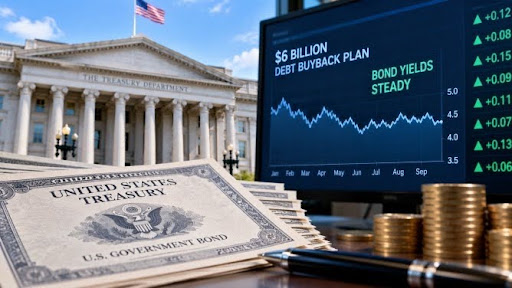
In an effort to alleviate rising borrowing costs, the U.S. Treasury has announced a plan to repurchase $6 billion in Treasury securities. Despite this initiative, bond market yields have continued their upward trend, signaling skepticism among investors. On Wednesday, Treasury Secretary Scott Bessent introduced the buyback strategy aimed at mitigating a selloff that has been driving interest rates higher. Yet, this move did not seem sufficient to calm the markets, as the yield on 10-year Treasury bonds climbed to a three-year peak.
The current climate has seen the 30-year Treasury yield surge to approximately 5.2%, marking its highest point since the financial turmoil of 2008. Investor confidence has been shaken by ongoing inflationary pressures and uncertainties stemming from the conflict in Iran, which have cast a shadow over U.S. government debt, typically considered one of the safest investments globally. In August, Bessent had indicated that the Treasury would amplify its debt buyback operations to at least double the usual scale to stabilize the market. The plan hinges on reducing the available bond supply, theoretically leading to lower yields, but the anticipated effect has yet to materialize.
As of August, U.S. government debt has exceeded $40 trillion, a figure that has doubled within the last ten years. The escalation in Treasury yields could potentially increase borrowing costs for consumers, impacting rates on mortgages, student loans, and auto financing. This situation poses a significant challenge for the U.S. Federal Reserve, which is grappling with persistent inflationary trends. Although annual inflation reached a three-year high in May, it eased to 3.4% in July, still considerably higher than the previous year’s level by 0.7 percentage points, largely driven by soaring energy prices.
The upward trajectory of oil prices has further compounded economic concerns, with Brent crude surpassing $100 a barrel on Wednesday amid the intensifying Middle East conflict. This scenario places the Federal Reserve in a precarious position as it seeks to balance inflation control through interest rate adjustments against political pressures, particularly from President Donald Trump, who has consistently advocated for reduced rates.