
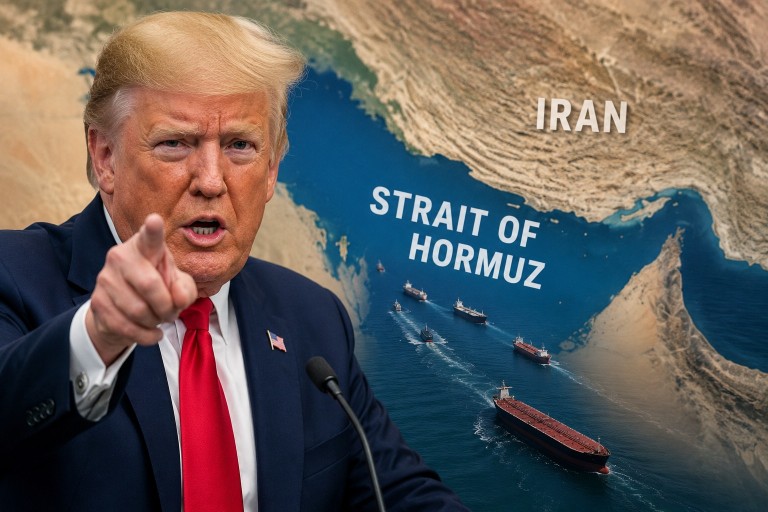
In a bold statement made in New York, US President Donald Trump has suggested that the United States may declare the Strait of Hormuz as its territory. This suggestion comes amidst ongoing tensions with Iran, as both nations struggle to find common ground and resolve their conflict. Trump indicated that this declaration could happen “pretty soon” following a US victory over Iran, asserting that the US already has significant control over the crucial waterway through a blockade.
The Strait of Hormuz is a vital artery for global oil transportation, with about 20% of the world’s seaborne oil supply passing through its narrow waters. It is strategically positioned between Iran and Oman. Since the onset of military operations by the US and Israel against Iran, the strait has largely remained closed, heightening international concerns. The US President’s remarks have raised questions about whether this signals a shift in official policy or merely serves as rhetoric.
Iran has firmly dismissed Trump’s threat, with Deputy Foreign Minister Kazem Gharibabadi emphasizing that Iran will not succumb to American pressure. He maintained that Iran retains control over decisions regarding the strait’s status. Additionally, Iranian Foreign Minister Abbas Araqchi has clarified that while there are communications being facilitated by Qatar and Pakistan, these do not equate to formal negotiations with Washington.
Tehran has stipulated several demands before it considers reopening the waterway, including reparations for war damages, the removal of sanctions, and the release of its frozen assets abroad. The disruptions in shipping through the Strait of Hormuz have contributed to rising fuel prices, which has intensified the financial burden on consumers. President Trump has justified the increased fuel costs, pointing out that these are a necessary trade-off to prevent Iran from developing a nuclear weapon.
The ongoing deadlock over the Strait of Hormuz continues to pose a risk to global energy supplies and has sparked fears about the broader economic ramifications of the conflict. As both sides remain entrenched in their positions, the international community watches closely, hoping for a resolution that could stabilize the region and lower global energy prices.