
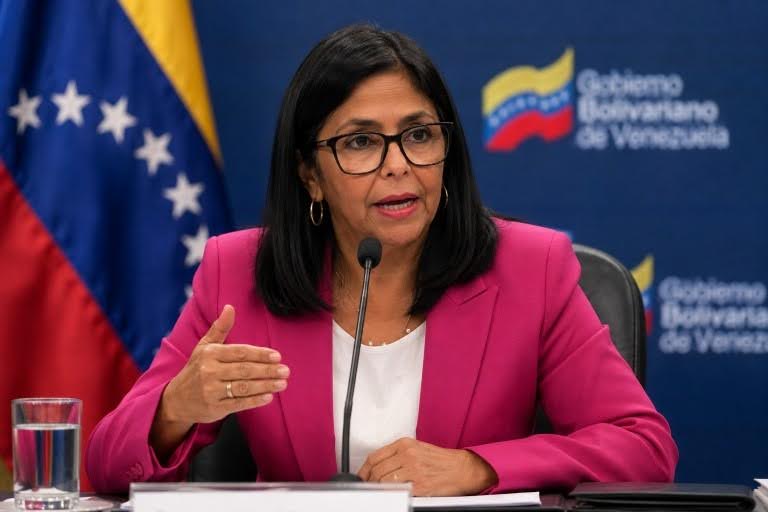
In a move that has stirred significant controversy, Venezuela’s interim president, Delcy Rodríguez, has come forward to defend a contentious energy deal with the United States. Despite facing intense criticism domestically, Rodríguez asserts that Venezuela maintains ownership and sovereignty over its oil resources. This defense follows her assumption of power earlier this year after Nicolás Maduro was ousted in a US-led operation. Addressing the nation, Rodríguez aimed to dispel accusations that she is ceding control of the country’s valuable resources to Washington.
Rodríguez emphasized the extensive benefits the agreement could bring, projecting potential revenue upwards of $209 billion, and positing that it could elevate Venezuela into a leading energy-producing nation. She argued that without the necessary investment, technology, and infrastructure, the country’s vast oil reserves remain untapped potential, unable to contribute to tangible economic growth for Venezuelans. The deal, reportedly negotiated in secrecy over several months, involves granting the US control over a significant portion of Venezuela’s crude reserves, which are the largest proven reserves globally, surpassing those of both Saudi Arabia and Iran.
Under the agreement, 17 strategic oilfields are included, with a production target set at over 1.5 million barrels daily. However, the announcement has sparked considerable backlash, not only from opposition figures but also from within Rodríguez’s own political ranks. Detractors have criticized the deal as a resource grab, with a former state oil executive labeling it a betrayal of national sovereignty. No previous transfer of reserves of this magnitude has occurred in Venezuela’s history, prompting protests in Caracas where demonstrators decried what they viewed as foreign intrusion, and social media users ridiculed the situation by suggesting a rebranding of the state oil company.
This development represents a stark reversal for Rodríguez and her political movement, historically known for resisting foreign control over Venezuela’s natural resources. Rodríguez herself had previously made public statements cautioning against such arrangements. Opposition leaders have voiced concerns that the deal could jeopardize efforts to reinstate democratic elections in the country, with lingering questions about the timing of future electoral processes. Critics contend that sustainable economic success hinges on transparent governance and free elections, cautioning that without these elements, the agreement could be built on a fragile foundation.