
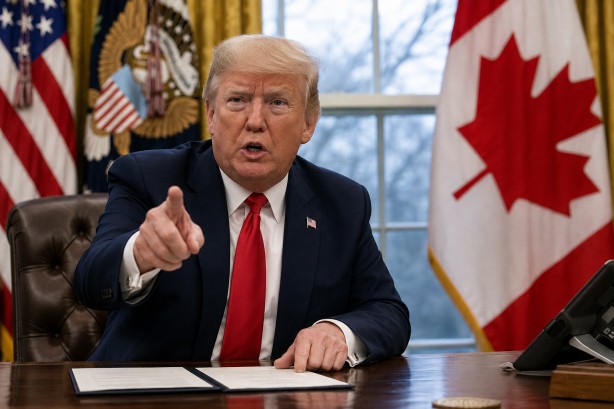
Tensions have intensified between the United States and Canada following a collapse in trade negotiations, with President Donald Trump directing sharp criticism at the neighboring nation. This development marks a further escalation in the ongoing trade dispute between the two countries.
In response, the United States has implemented a 50% tariff on approximately $20 billion worth of Canadian imports, impacting a variety of goods. Canadian Prime Minister Mark Carney has vowed to retaliate with equivalent tariffs, asserting that Canada refuses to accept the terms set forth by Washington. Carney has characterized the situation as a trade war, accusing the U.S. of launching an economic attack against Canada. Meanwhile, Jamieson Greer, the U.S. Trade Representative, has justified the tariffs as a necessary measure to safeguard American workers and supply chains.
The escalating conflict has sparked concern among businesses and legislators in both nations. Canadian business associations have cautioned that exporters and small businesses might suffer substantial revenue declines. Concurrently, U.S. lawmakers from states bordering Canada have expressed worries that the tariffs could drive up costs for businesses, farmers, and consumers.
Canada’s retaliatory tariffs are slated to become effective on September 8, targeting products such as steel, dairy items, appliances, and electronics. These measures are seen as a direct response to the U.S. tariffs, highlighting the intensifying trade tensions.
The ongoing dispute has also cast a shadow of uncertainty over the future of the US-Mexico-Canada trade agreement, which plays a critical role in regulating a significant portion of trade across North America. The outcome of this conflict could have profound implications for the economic landscape of the region.