
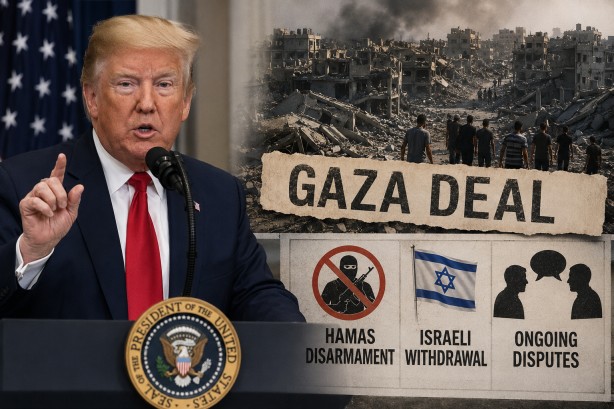
President Donald Trump announced a significant development in the efforts to resolve tensions between Israel and Hamas, revealing an agreement that centers on the disarmament of Hamas and the withdrawal of Israeli forces from Gaza. The proposal is touted as a pivotal move towards establishing a new Palestinian administration in Gaza while safeguarding Israel’s enduring security. This plan builds on previous ceasefire initiatives and requires Hamas to surrender its weapons and dismantle its tunnel network. In exchange, Israeli troops would withdraw, paving the way for a technocratic Palestinian government to take shape, supported by an international security force and the reconstruction of Gaza.
Despite the plan’s ambitious scope, substantial disagreements persist regarding its implementation. Hamas has maintained that disarmament will commence only after a complete Israeli withdrawal from Gaza, emphasizing that both parties must adhere to their commitments concurrently. Conversely, Israeli officials stipulate that the complete disarmament and demilitarization of Gaza must precede any troop withdrawal. U.S. officials have acknowledged these significant differences and expressed concern about Hamas’s compliance with disarmament provisions.
In a move aligned with the broader proposal, Hamas has announced its intention to dissolve its governing administration in Gaza, transitioning authority to a technical committee endorsed by the United Nations. This shift is part of ongoing discussions involving mediators from Egypt, Qatar, and Turkey, which are expected to continue to hammer out the details of implementing the agreement.
Meanwhile, despite these diplomatic efforts, conflict on the ground persists. Israeli military operations and airstrikes continue in Gaza, with Israel signaling plans to expand its military control over the territory. These developments underscore the complexities and challenges inherent in achieving a long-term ceasefire agreement.