
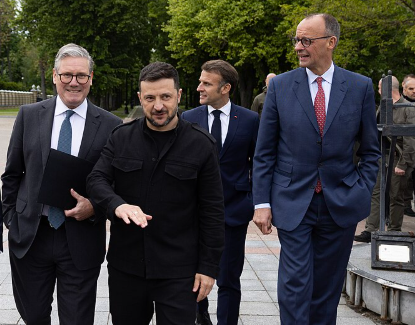
A critical week for the future of Ukraine is unfolding both in the corridors of power and on the blood-soaked streets of the Donbas. While leaders from the US, UK, France, Germany, and Ukraine engage in frantic diplomacy, the war on the ground rages with renewed intensity. In the eastern city of Myrnohrad, Ukrainian soldiers describe the situation as “absolute hell,” confirming that street battles are underway. Russian forces, reportedly ordered by Putin to complete the takeover, are also storming the northern parts of Pokrovsk using a mix of heavy armor and fast-moving vehicles.
Against this backdrop of violence, a “coalition of the willing” is set to hold a crunch video call on Thursday. The group, which includes President Zelenskyy, Prime Minister Keir Starmer, President Emmanuel Macron, and Chancellor Friedrich Merz, is attempting to finalize a peace plan to present to the United States. The urgency is driven by a chaotic push from the Trump administration to secure a deal, a drive that has left European allies scrambling to keep up. Zelenskyy is expected to hand over a revised version of his plan to US negotiators just hours before the leaders convene.
However, the diplomatic path is fraught with obstacles. President Trump has openly criticized his European counterparts, accusing them of “wasting time” and threatening to withhold US participation in future talks if progress isn’t made immediately. The friction was evident in a phone call on Wednesday, which Trump described as having “strong words” and “little disputes.” The US President’s skepticism poses a major challenge for Zelenskyy, who relies on American support but finds himself increasingly isolated by Washington’s demands.
Compounding the crisis for Kyiv is the intense pressure to hold wartime elections. Trump has questioned Ukraine’s democratic status, prompting Zelenskyy to announce his readiness to hold a vote within 90 days if security can be guaranteed. This concession marks a significant departure from previous Ukrainian policy and highlights the extent of the leverage the US currently holds. At the same time, Zelenskyy is dealing with internal instability following the firing of his chief of staff due to a corruption scandal.
The stakes for Thursday’s meeting could not be higher. European leaders are working to draw up security guarantees for Ukraine in the event of a ceasefire, but it remains unclear if these will be enough to deter a third Russian invasion. With the US seemingly pivoting toward a deal that could cede territory to Russia, and Moscow praising Trump’s “understanding” of the war, Zelenskyy and his European allies face a narrow window to shape a peace that does not look like a surrender.